
Do you know what…?
Why did Neptune’s moon outshine the planet in Webb’s near-infrared image?
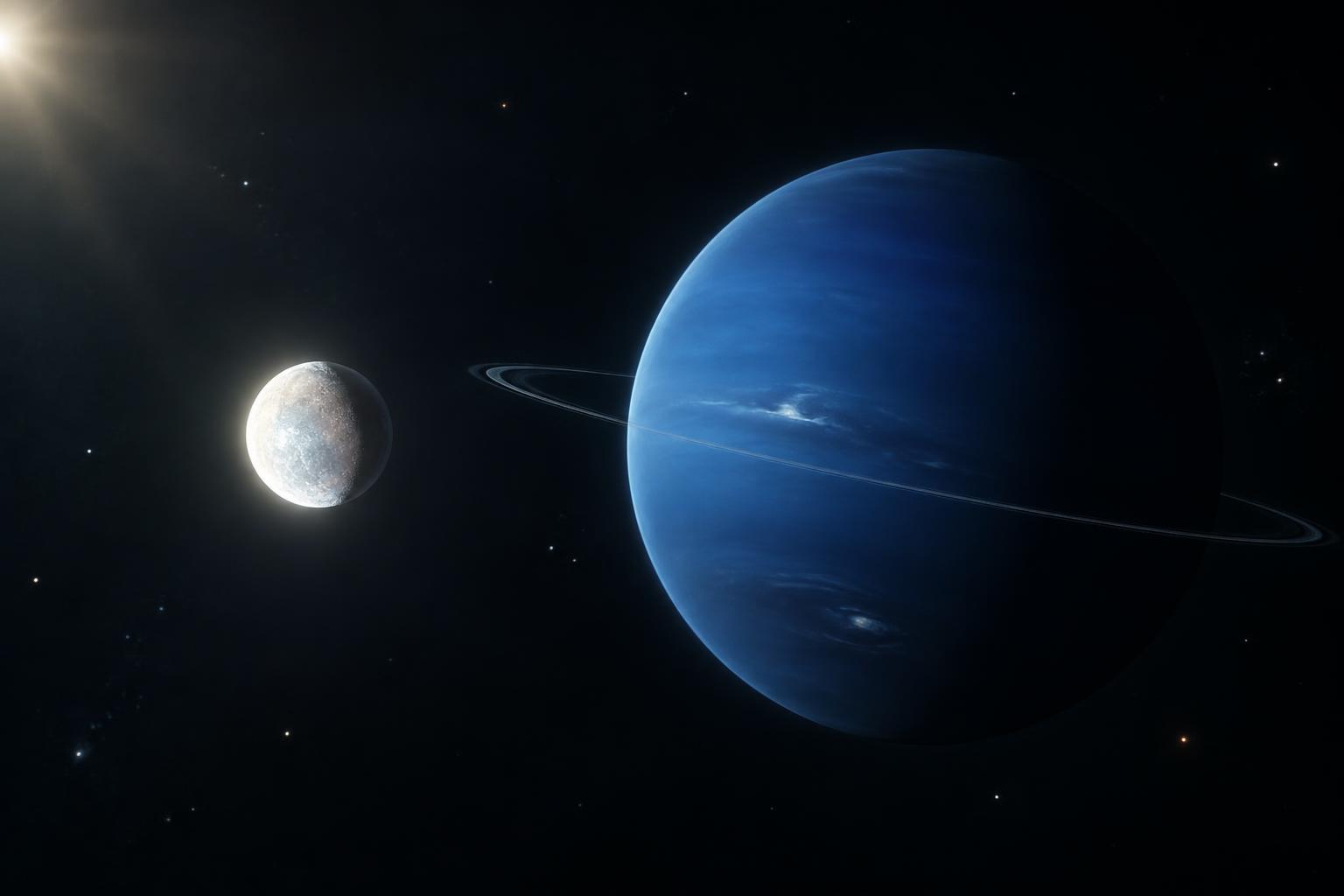
AI-generated image, not a photograph. This edition's article, audio and test are AI-generated and published automatically without prior human review. Sources · Editorial & AI Policy
Listen to today’s article
In the Webb image NASA released on 21 September 2022, Neptune is upstaged by its own moon. The point with diffraction spikes is Triton, not a distant star. That appearance is at odds with the assumption that a planet must dominate its satellites visually. Triton's surface is coated in frozen nitrogen; NASA says it reflects an average of 70 per cent of incoming sunlight. That average is not a wavelength-specific measurement made by Webb. Neptune, meanwhile, looks dark because atmospheric methane absorbs light at the near-infrared wavelengths shown. The contrast concerns this image, not the objects' total energy output.
The bright cloud markings on Neptune are in keeping with that explanation, not exceptions to it: high-altitude methane-ice clouds reflect sunlight before methane gas can absorb it. What looks like a contradiction can therefore where reflection occurs in an atmosphere. The image also recovered a subtler signal: some rings had gone undetected since Voyager 2 passed Neptune in 1989, and faint dust bands were visible too. Webb did not discover the rings. Rather, the observation brought previously structures back into view, demonstrating why an image's scientific value need not reside in its most dazzling feature.
Such observations are not simply portraits; they are evidence whose interpretation is contingent on the wavelengths examined. Changing the wavelength can change which materials and structures stand out, so the displayed scene should not be mistaken for an unaided human view. NASA's report on 26 March 2025 provides a concrete continuation: Webb observations using its Near-Infrared Spectrograph revealed auroral activity on Neptune, with data obtained in June 2023. That later result concerns a different phenomenon, not a new explanation for Triton's brightness. The enduring lesson is to ask what the light reveals, rather than assume that the brightest object matters most.