FIVEBREAK — Pro-Level English

Stay informed. Take your English further. Five minutes. Every day.

Culture · Your daily 5 minutes

Past Editions →

Do you know what…?

Why did the Library of Congress buy slower records for blind readers?
Sunday 1 November 2026

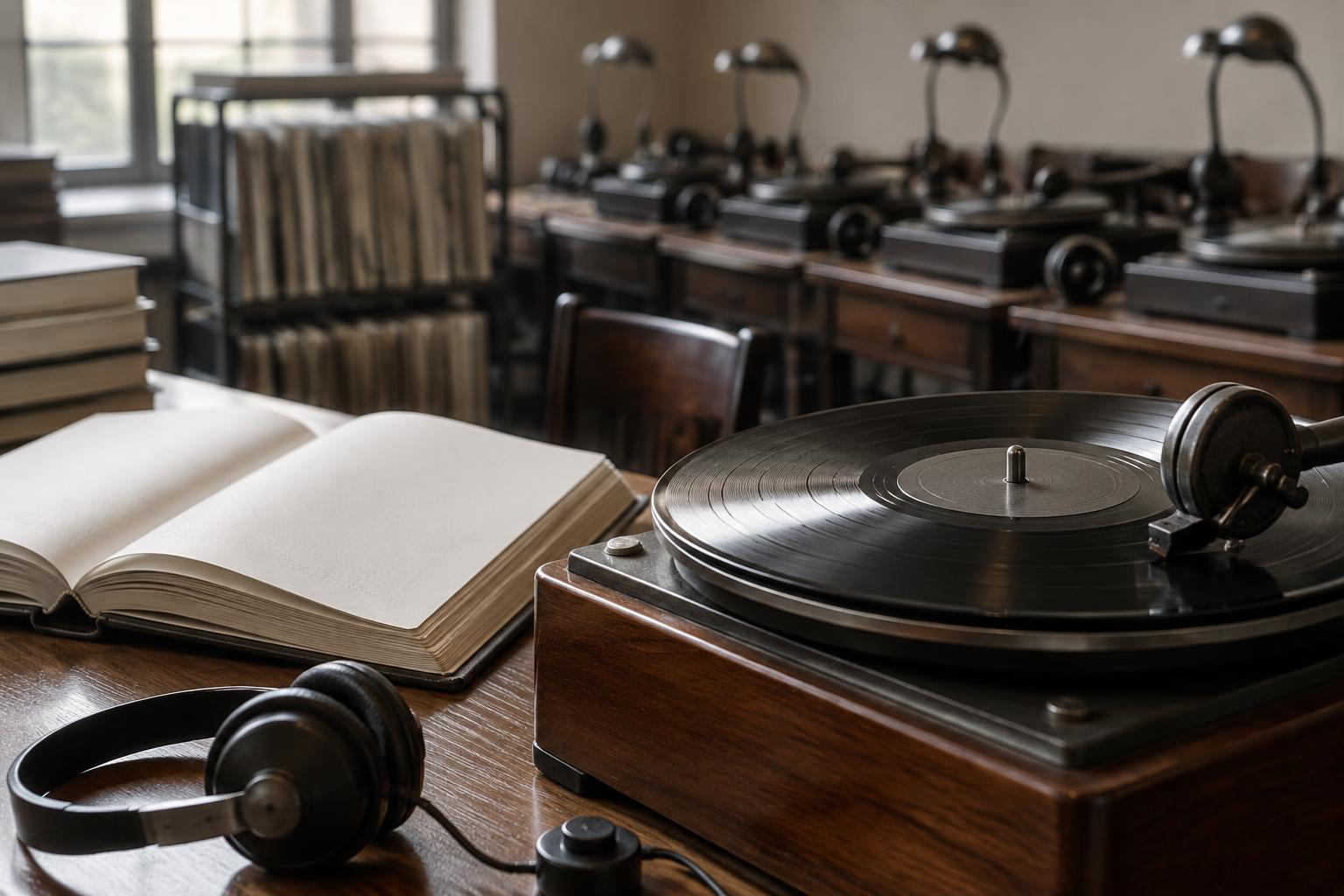
AI-generated image: conceptual illustration of an open book beside a record-playing machine, with further machines receding behind it to suggest the infrastructure of accessible reading.

AI-generated image, not a photograph. This edition's article, audio and test are AI-generated and published automatically without prior human review. Sources · Editorial & AI Policy

Listen to today’s article

0:00 / 0:00

In 1934, the Library of Congress bought records that put literary duration ahead of the commercial norm. Produced by the American Foundation for the Blind, these talking books used 12-inch discs turning at 33⅓ revolutions per minute, rather than the 78 rpm common in commercial recordings. Each side held about 15 minutes of speech: slowing the record helped accommodate sustained reading, rather than just a brief performance. Early orders ranged from Shakespeare's plays and P. G. Wodehouse's Very Good Jeeves to major American civic documents. The challenge was to make substantial works available through sound.

But a recording could not, by itself, give someone access to a book. Playback equipment was : the Library's initial covered no machines. That gap turned a literary service into a manufacturing . In 1936, the New York Works Progress Administration began building talking-book phonographs; by the project's end in 1942, it had produced more than 23,000 machines. This was not simply a matter of hiring narrators or choosing titles. A usable service also depended on equipment and distribution, although manufacturing those machines did not establish that every blind reader could obtain one.

The same design priority outlasted the record. The federal programme now known as the National Library Service for the Blind and Print Disabled (NLS) later combined slower cassette recording with four monaural tracks, fitting up to six hours onto a cassette. Its October–December 2024 newsletter introduced the DA2 audiobook player, showing that dedicated listening equipment remains part of accessible reading. These are not merely successive containers for the same content. They illustrate a cultural principle: making a work available is different from making it usable. Access depends on the whole chain, from the literary work to the means of hearing it.

Sources (4)

Today’s expression

the missing piece

Meaning: The element whose absence prevents a plan or system from working fully.

Example: The team had excellent data, but practical experience was the missing piece.

Check your understanding

15-question test

Answer all the questions, then check your results.

  1. True / False

    1.The Library's early talking-book orders included both literary works and American civic documents.
  2. 2.The Library's initial funding provided both recordings and the machines needed to play them.
  3. 3.The article presents dedicated playback equipment as something that disappeared after the cassette era.
  4. Reading Comprehension

    4.What practical advantage did the slower talking-book records offer?
  5. 5.What had the New York public-works project achieved when it ended?
  6. 6.Inference: What broader lesson does this history offer an institution planning an accessible cultural service?
  7. Grammar & Phrasal Verbs

    7.Which sentence would sound most natural in professional English?
  8. 8.Which reformulation best preserves the article's distinction between availability and usability?
  9. 9.Which expression could replace 'depended on' in the article without changing its meaning?
  10. Prepositions

    10.Complete the sentence: 'The talking books were produced ___ the American Foundation for the Blind.'
  11. 11.Complete the sentence: 'A usable service depended ___ equipment and distribution.'
  12. 12.Complete the sentence: 'The format allowed up to six hours of material to fit ___ a cassette.'
  13. Vocabulary & Synonyms

    13.What does 'the missing piece' mean when applied to playback equipment?
  14. 14.What does 'appropriation' mean in the context of the Library's programme?
  15. 15.Which word is closest to 'undertaking' in 'a manufacturing undertaking'?

0 / 15 answered